Key Points
- A caregiver provides physical, medical, or emotional support to someone who cannot fully care for themselves, either as a paid job or as a family member.
- Professional caregivers earn a median of $17.21 an hour, with most of the field between $13.00 and $21.65 depending on setting and state.
- Family members can get paid to provide care through Medicaid self-directed programs and the VA caregiver program, though most states exclude spouses specifically.
- Caregiver burnout is common and has recognizable early signs worth watching for.

What Is a Caregiver?
A caregiver is a person who helps someone else with the daily activities they can no longer manage on their own, including bathing, dressing, meals, medication, and getting to appointments. Caregiving is the work itself, whether it is paid or not.
Three words get used for the same role. Caregiver is the standard term in American professional and clinical settings, written as one word rather than two. Carer means the same thing and is the usual word in British and Australian English. Caretaker is trickier, because Merriam-Webster lists two senses: one who gives physical or emotional care, and one who looks after the house or land of an absent owner. In the United States the property meaning is common enough that caregiver is the safer word when you mean a person.
Two more distinctions matter. A primary caregiver is whoever carries the main responsibility, paid or not, and is usually a family member. An in-home caregiver is someone hired to provide that care in the client's home.
What Does a Caregiver Do? Duties and Responsibilities
Caregiver duties cluster into five areas, and most jobs draw from all of them.
- Personal care: bathing, dressing, grooming, and helping someone move safely between a bed, a chair, and a bathroom.
- Health related support: medication reminders, coordinating appointments, and noticing when symptoms change.
- Household support: preparing meals, light housekeeping, and driving to the pharmacy or the doctor.
- Companionship and emotional support, which sounds soft and is often the part clients value most.
- Safety supervision, which matters most for someone with dementia or a history of falls.
The mix shifts with the setting. A family caregiver may handle all five and never think of them as job duties. A professional working through an agency may be assigned only two or three, with skilled tasks reserved for a nurse.
Hours vary too, though not in the direction most people assume. BLS reports that most aides work full time, that part-time work is common, and that schedules may include evenings and weekends depending on client needs. On the family side, AARP and the National Alliance for Caregiving found that the 63 million Americans providing ongoing care spend an average of 27 hours a week doing it. That is not helping out. That is most of a second job.
Types of Caregivers
Four labels cover most of the field, and they overlap more than they separate.
- A family or informal caregiver is a relative or friend doing the work unpaid, usually without training. This is by far the largest group.
- A professional in-home caregiver is hired to do much the same work in the client's home, through an agency or directly by the family.
- A live-in caregiver is a professional who resides in the home, which changes the pay structure more than it changes the tasks.
- A primary caregiver is not a job title but a role. It is whoever carries the main responsibility, and any of the three above can hold it.
Caretaker gets used loosely for all four in everyday speech. The categories are not fixed either. A daughter who starts out informal can end up hired and paid through her state's Medicaid self-directed program, doing the same tasks she was already doing, now with a timesheet.
How to Become a Professional Caregiver
Becoming a paid caregiver takes less than most people expect, and how much less depends entirely on who employs you.
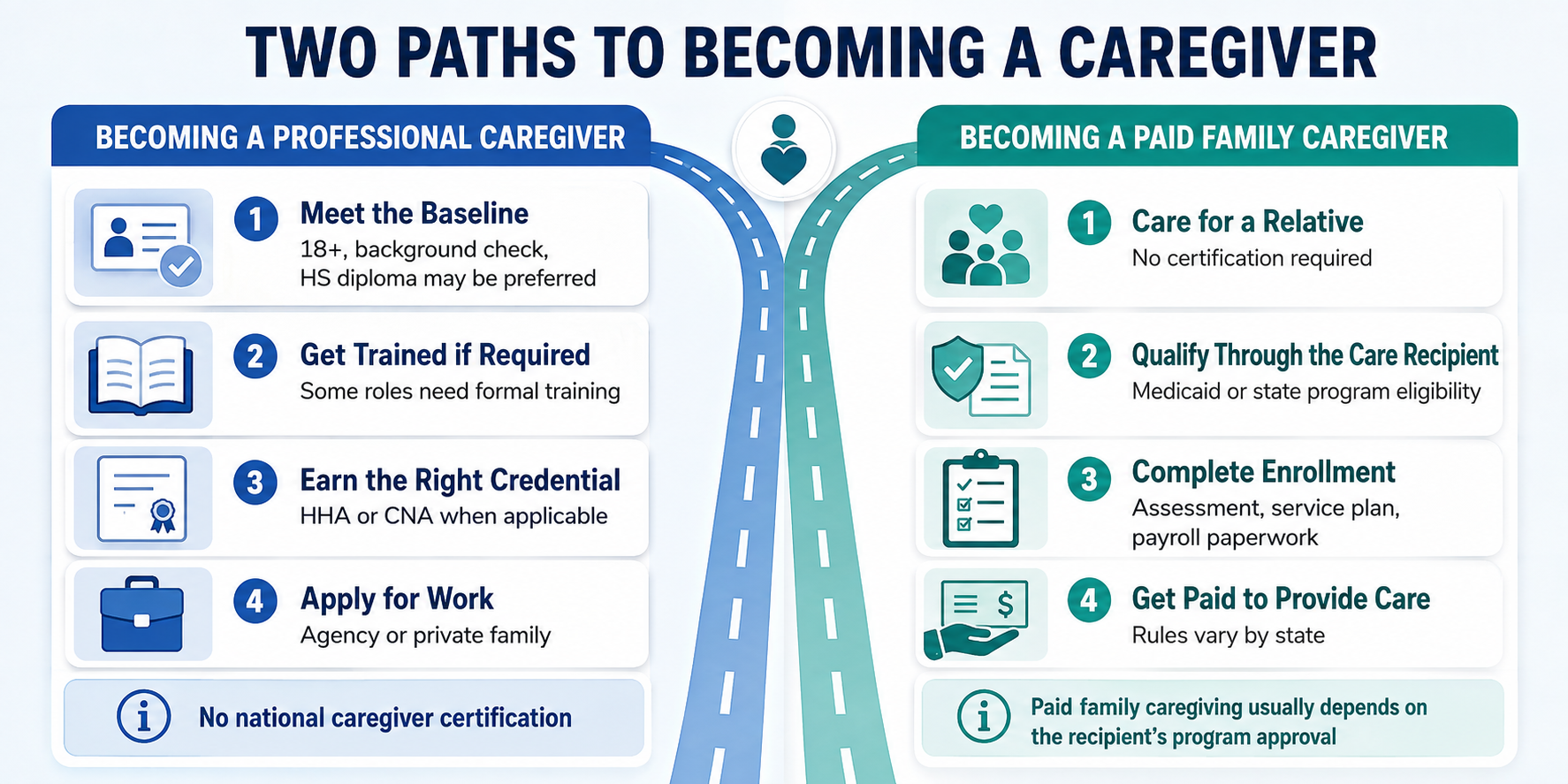
- Meet the baseline. Most employers want you to be 18, pass a criminal background check, and hold a high school diploma or equivalent, though BLS notes some positions require no formal credential.
- Get trained, if your category requires it. This is where the paths split. An aide working for a Medicare-certified home health or hospice agency falls under federal rules, which require at least 75 hours of training, including a minimum 16 classroom hours before a minimum 16 hours of supervised practical training, plus a competency evaluation. An aide doing non-medical work for a private client may face no training requirement at all.
- Get certified where it applies. There is no national caregiver certification. Certified nursing assistant and home health aide are the credentials that carry weight, and both are regulated state by state.
- Apply through a home care agency, which handles scheduling, payroll, and client matching, or work directly for families.
California runs its own process. Registering with the Home Care Aide Registry costs $35, takes Live Scan fingerprints, and requires you to be 18. No training hours are required to register. Work for a home care organization and state law adds two conditions: registry clearance before you meet a client, and proof you are free of active tuberculosis. Our guide to becoming a caregiver in California walks through the rest of that process.
Caregiving is often the entry point rather than the destination. The step up is a CNA or medication aide credential, and Williams Career School of Excellence in San Marcos, Texas requires medication aide applicants to already be working as a caregiver or CNA. Dreambound listings for these credentials are concentrated in Texas right now.
How to Become a Caregiver for a Family Member
No certification is required to care for your own mother, father, or spouse. Anyone can do it, and 63 million Americans already are.
Getting paid for it is a different matter, and the gate sits somewhere people do not expect. You are not the one who has to qualify. The person you care for is. Medicaid self-directed programs run on the care recipient's eligibility and a needs assessment, which is why there is no application you can file on your own behalf.
Once that approval is in place, the enrollment steps are mostly administrative. Expect three:
- A service plan setting out what care is authorized and how many hours it covers.
- Paperwork through a fiscal intermediary, which handles wages and tax withholding.
- Training, in a few states. Washington tells paid family caregivers that most complete 35 hours within 120 days of hire, while exempting them from the Home Care Aide certification it requires of facility workers.
Which relatives qualify varies by state. Medicaid is also only one of three routes that pay family caregivers, and they do not work the same way.
How Much Do Caregivers Make?
Two numbers answer this question, and they are nowhere near each other.
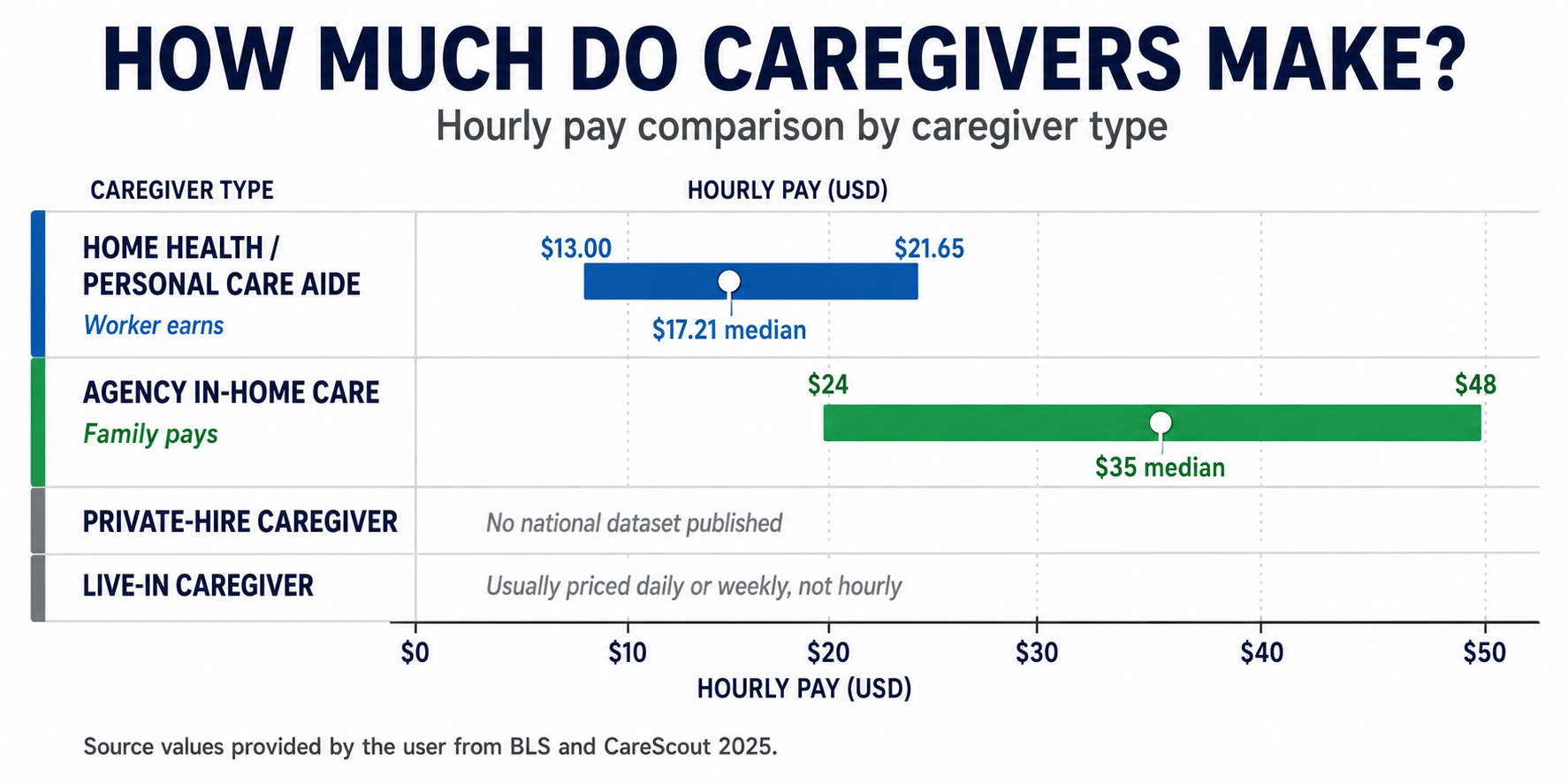
BLS Occupational Employment and Wage Statistics for May 2025 puts the median wage for home health and personal care aides at $17.21 an hour, or $35,800 a year. The bottom 10% earn $13.00 and the top 10% reach $21.65. That is what the worker takes home.
The CareScout 2025 Cost of Care Survey puts the national median cost of a non-medical caregiver at $35 an hour, ranging from $24 in Mississippi to $48 in Wyoming. That is what a family pays an agency for the same visit.
Two of those rows carry no number for a reason. Nothing authoritative breaks out what a privately hired caregiver earns, because BLS does not split the occupation by employer type and CareScout surveys agencies only. Live-in arrangements are usually negotiated as a flat daily or weekly rate, so an hourly figure would be misleading even if one existed.
The distance between the first two rows covers the agency's overhead, insurance, scheduling, payroll taxes, and margin. It is also why hiring privately often costs a family less per hour and pays the caregiver more, and why it moves the payroll, tax, and liability paperwork onto the family.
The five largest states for caregiver employment, set against the national figure:
Together those five employ more than half the country's aides. What a family pays barely moves across them, from $30 to $40. What a caregiver earns moves twice as much, from $11.65 to $19.05. Geography changes the wage far more than it changes the price.
Texas is the sharpest case. Its median aide wage of $11.65 sits below the national 10th percentile of $13.00, which means half of the state's 329,590 aides earn less than the lowest-paid tenth nationally. Annual median there is $24,230. Our guide to becoming a caregiver in Texas covers the state's own requirements.
California runs the other way. Families pay the most of any large state at $40 an hour, while California caregivers earn a median of $16.50, below the national figure. The state's 10th, 25th, and 50th percentile wages are all $16.50, which is what a wage floor looks like in data.
How to Get Paid as a Family Caregiver
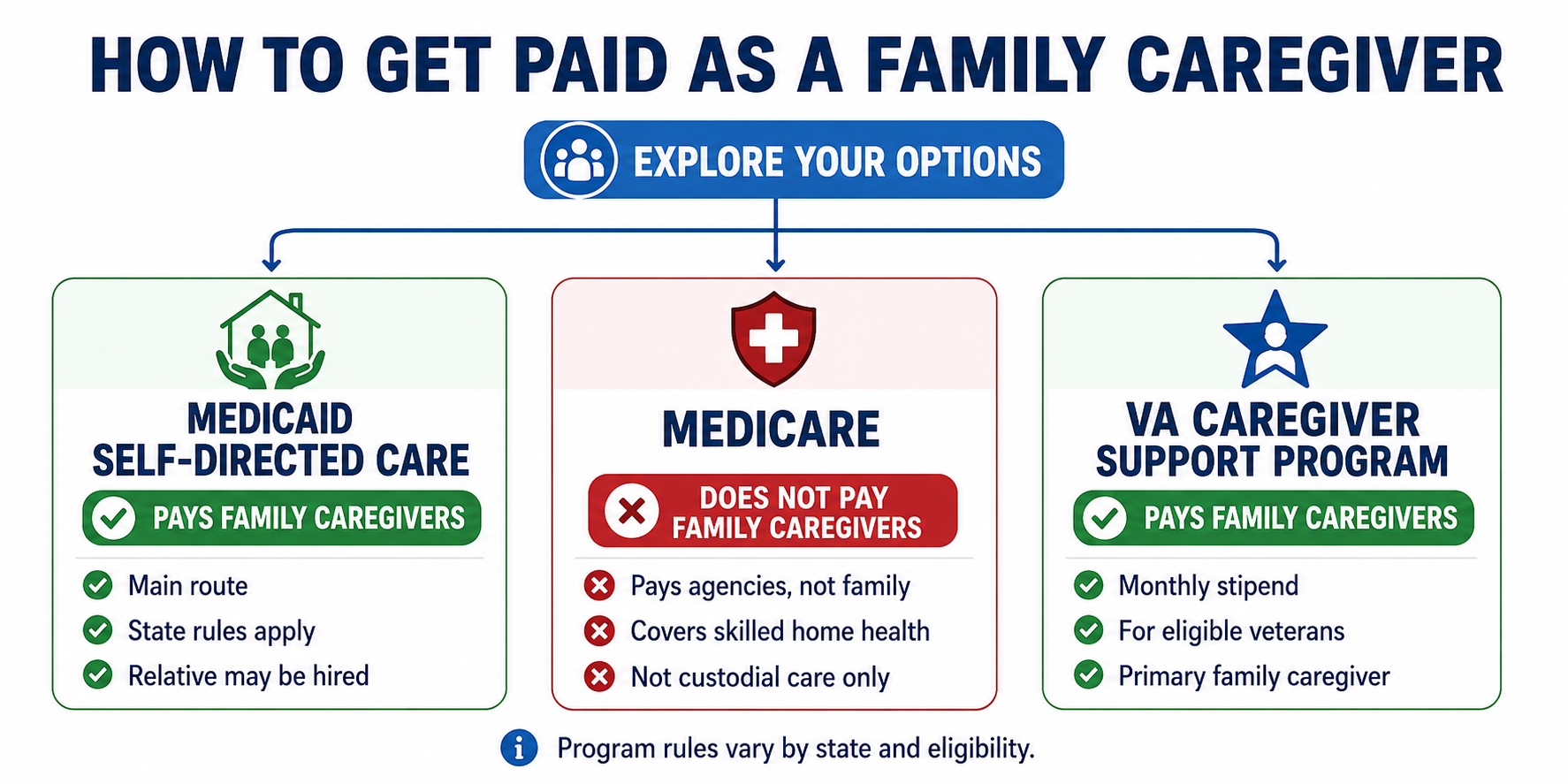
Three programs pay family caregivers, and they work nothing alike. One runs through your relative's Medicaid eligibility, one covers veterans only, and one does not pay family members at all.
Medicaid Self Directed Care Programs
This is the main route. The American Council on Aging reports that all 50 states and the District of Columbia run some form of Medicaid-funded consumer directed personal care assistance, and Medicaid.gov describes participants as holding employer authority, the right to recruit, hire, train, and supervise whoever provides their services. A relative can be that person.
What the program pays is set by the state and by an assessment of the care recipient's needs, so there is no national rate. New York runs its version as the Consumer Directed Personal Assistance Program, where a personal assistant cannot be the member's spouse, their designated representative, or the parent of a consumer under 21. Our guide to becoming a caregiver in New York goes further into how that program works.
Does Medicare Pay Family Caregivers?
No, and this is the most common confusion in caregiving. Medicare is health insurance; Medicaid is the program that funds long-term care. Medicare.gov states plainly that Medicare does not pay for "custodial or personal care that helps you with daily living activities (like bathing, dressing, or using the bathroom), when this is the only care you need," nor for 24-hour home care. It covers a home health aide only alongside skilled nursing or therapy, and it pays the agency, not your family.
VA Caregiver Support Program
The Program of Comprehensive Assistance for Family Caregivers pays a monthly stipend directly to a designated Primary Family Caregiver. Eligibility requires a service-connected disability rating of 70% or higher and a need for in-person personal care for at least six continuous months. The stipend comes with CHAMPVA coverage for uninsured caregivers, counseling, travel reimbursement, and at least 30 days of respite care a year.
The amount is formula-driven, not fixed. Federal regulation sets it as a percentage of the OPM General Schedule grade 4, step 1 annual rate for the veteran's locality: 1.00 for caregivers of veterans unable to self-sustain in the community, and 0.625 otherwise. The same regulation provides for retroactive payment of stipend differences in defined reassessment situations, which is what people are asking about when they search for back pay.
State Specific Spouse Pay Rules
Spouses are the most common exclusion. The ARCH National Respite Network states that in most states, spouses are excluded from being paid. New York bars them from CDPAP outright, and Washington says plainly that spouses cannot be paid to care for each other. Adult children, siblings, and other relatives face fewer restrictions. Check your own state's program before assuming either way.
Caregiver Tax Credit and Reporting Caregiver Income
There is no federal caregiver tax credit as such. The closest is the Credit for Other Dependents, worth up to $500 for a qualifying dependent. The Child and Dependent Care Credit is a different thing entirely: it applies when you pay someone else for care so that you can work, not when you are the one providing it.
Payments you receive for caregiving are generally taxable income. One exception matters enormously. Under IRS Notice 2014-7, Medicaid Home and Community-Based Services waiver payments are excludable from gross income as difficulty of care payments when the care happens in the provider's own home where the recipient also lives. Family members qualify. This is general information, not tax advice, and a tax professional should look at your situation.
Caregiver Burnout: Signs and How to Cope
Caregiver burnout is the point where sustained caregiving starts damaging the caregiver's own health. The National Institute on Aging reports that caregivers carry a higher risk of physical and mental health problems, sleep trouble, and chronic conditions such as high blood pressure.
NIA lists the warning signs, and the early ones are easy to explain away:
- Feeling exhausted, overwhelmed, or anxious
- Becoming easily angered or impatient
- Feeling lonely or disconnected from others
- Trouble sleeping, or not getting enough sleep
- Losing interest in things you used to enjoy
- Frequent headaches, pain, or other physical problems
- No time to exercise or prepare decent food for yourself
- Skipping showers or brushing your teeth
What helps is unglamorous and it works: respite care so the schedule has gaps in it, a support group where nobody needs the situation explained, and boundaries set at what you can sustain rather than what you wish you could.
One situation deserves separate mention. When the person you care for cannot recognize their own condition, that is often anosognosia, which the Alzheimer's Association describes as a symptom of a neurological condition rather than denial, caused by changes in the brain regions responsible for self-awareness. Arguing does not work because there is nothing to persuade. The Association advises simple language, redirection instead of confrontation, and building safety into the home and the routine rather than trying to restore insight.
If the signs above describe your last few months, that is worth raising with your own doctor, not just noting.