10 In-Demand IT Certifications for Beginners (2026)
See if you qualify for training programs
Answer a few questions in 2 minutes. Free, no commitment.
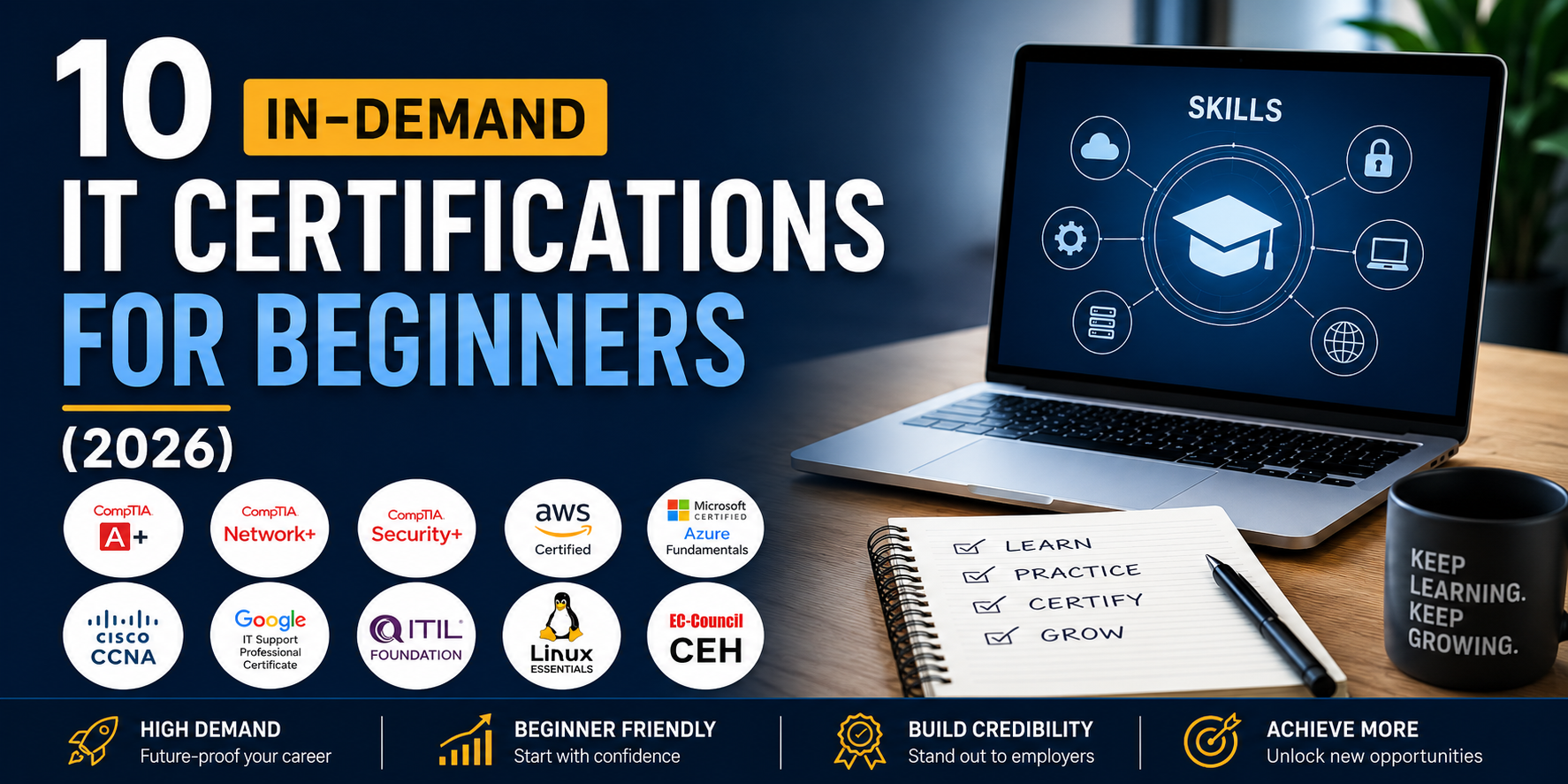
The best IT certification for beginners depends on the first IT role you want, not on which credential has the biggest brand name. Computer support specialists earn a median annual wage of $61,550 according to May 2024 BLS data, and the broader computer and information technology field pays a median of $105,990 with about 317,700 openings projected each year through 2034. Most beginners should start with a foundation credential like CompTIA A+, Google IT Support, or a cloud or security fundamentals exam before moving into advanced certifications. Some options on this list are full certification exams, while others are certificate programs that build beginner skills before an exam. Match the credential to your target first role, then commit to one path rather than collecting credentials that don't connect.
IT Certification Salary and Job Outlook
Salary and job outlook for IT careers depend on the role, certifications, employer, location, and hands-on experience. Certifications support your training but do not guarantee a specific salary or position.
BLS reports a median annual wage of $61,550 for computer support specialists as of May 2024. Within that group, computer user support specialists earned $60,340 and computer network support specialists earned $73,340. Overall employment is projected to decline 3% from 2024 to 2034.
Despite the projected decline, BLS still projects about 50,500 openings per year on average for computer support specialists, driven largely by replacement needs as workers transfer to other occupations.
For cybersecurity-focused students, BLS reports a median annual wage of $124,910 for information security analysts in May 2024. Employment is projected to grow 29% from 2024 to 2034, with about 16,000 openings per year on average.
For networking-focused students, BLS reports a median annual wage of $96,800 for network and computer systems administrators in May 2024. Employment is projected to decline 4% from 2024 to 2034, with about 14,300 openings per year on average.
Across the broader computer and information technology field, the median annual wage was $105,990 in May 2024. BLS projects roughly 317,700 openings per year through 2034, which BLS describes as much faster than the average for all occupations.
Long-term earnings in IT depend less on the starting credential and more on hands-on experience, troubleshooting ability, communication skills, and continued certification stacking.
Dreambound is a free platform that helps you compare IT training programs across the United States. Filter programs by the certification each one prepares you for, starting from the role you're targeting first.
IT Certification Training Programs on Dreambound
The programs below are organized by track so you can compare IT support, cybersecurity, and networking or cloud options side by side. Program details can change, so confirm current tuition, length, format, certification preparation, and financial aid on each program page before applying.
IT Support and Help Desk Programs
These programs prepare students for entry-level IT support work, with curriculum centered on CompTIA A+ topics, hardware troubleshooting, and customer service. Most operate fully online with self-paced or accelerated formats.
Computer Support Technician — CCI Training Center
- Format: Online
- Prepares students for industry-recognized credentials including CompTIA, CCNA, AWS, and Security-related certifications
Computer Support Specialist — Southern Careers Institute
- Format: Online
- Covers hardware, software, networking, troubleshooting, and customer service basics, with the opportunity to earn industry-recognized certifications
IT Support Specialist Career Diploma — Penn Foster
- Format: Online, self-paced
- Covers hardware, software, networking, security, cloud computing, and mobile device topics
Cybersecurity Programs
These programs focus on the certifications most often required for entry-level cybersecurity work, including CompTIA Security+ and the broader CompTIA security stack. Both options listed below are online and stackable, meaning students prepare for multiple credentials within a single program.
Information Technology Security and Administration — MyComputerCareer
- Format: Online
- Prepares students for CompTIA A+, Network+, Security+, Linux Essentials, Microsoft Azure AI Fundamentals, and Microsoft Azure Fundamentals
- Includes lifetime career services
Cyber Warrior Program — MyComputerCareer
- Format: Online, with campus support available in Columbus, OH and Dallas, TX
- Length: 12 weeks
- Prepares students for up to four CompTIA certifications: A+, Network+, Security+, and CySA+
Networking, Cloud, and AI Programs
These programs prepare students for networking, cloud fundamentals, and AI literacy certifications across multiple vendors. They suit students who want broader infrastructure exposure or a pathway toward an associate degree alongside industry credentials.
Computer and Network Administration, IT Security — CCI Training Center
- Format: Online, accelerated course structure (about three weeks per course)
- Outcomes cover IT Security, Help Desk, PC Support, Network Support, and Computer Support Specialist roles
Students weighing certification training against a longer credential path may look at community college degrees with high earnings before committing.
Frequently Asked Questions
What is the easiest IT certification to get as a beginner?
CompTIA Tech+ (formerly CompTIA IT Fundamentals / ITF+) and the Google IT Support Professional Certificate are the most accessible starting points for beginners with no prior experience. Both cover foundational concepts at a slower pace than CompTIA A+ and require no prerequisites. ISC2 Certified in Cybersecurity is another low-friction option since it requires no prior experience and costs $199 to sit for.
Can you get an IT job with just a certification and no experience?
Yes, many entry-level IT support and help desk roles do hire candidates with a certification and no prior IT job experience, especially when paired with demonstrable hands-on practice. CompTIA A+ and Google IT Support are the credentials hiring managers most often look for at this level. The certification by itself usually isn't enough; employers also want evidence of troubleshooting, customer communication, and self-directed practice through home labs, volunteer support work, or completed projects.
How long does it take to earn a beginner IT certification?
Most beginners spend two to six months preparing for a foundation IT certification, depending on study pace, prior exposure, and whether they're enrolled in a structured training program. CompTIA A+ and Network+ typically take two to four months of consistent study. The Google IT Support Professional Certificate is designed for three to six months of self-paced learning. AWS Cloud Practitioner and Microsoft Azure Fundamentals often take four to eight weeks of focused study.
Do IT certifications expire?
Most major IT certifications renew on a three-year cycle. CompTIA certifications such as A+, Network+, and Security+ require either retaking the exam or earning continuing education units within three years. Cisco CCNA and CCST also renew every three years through continuing education or recertification. AWS and Microsoft cloud certifications generally renew every one to three years. The Google IT Support Professional Certificate is a one-time credential and does not expire.
Should I start with CompTIA A+ or Google IT Support?
CompTIA A+ is the stronger choice if you want a recognized industry certification that employers actively screen for in entry-level support job postings. Google IT Support is the stronger choice if you need a guided, structured learning path with no prior IT background and want to build toward A+ afterward. Many students complete Google IT Support first and then sit for CompTIA A+ because the topics overlap heavily. Dreambound can help you compare IT support programs that prepare students for either credential.
Choosing Your First IT Certification Path
The mental model that makes beginner IT certifications click is sequencing: first role, then credential, then training program, not chasing the biggest brand name. Once you know whether you're aiming at help desk, networking, cybersecurity, cloud, or AI support, the right starting credential is usually obvious, and the next certification on that path becomes obvious shortly after.
Use Dreambound to compare beginner IT certification training programs by the specific exam each prepares you for. Start with the role you want first, filter programs by that credential, and commit to one path rather than collecting certifications that don't connect to a single job target.