Key Points
- IT support is typically the lowest-barrier entry point into IT, but has a lower salary ceiling than most adjacent tracks.
- Cybersecurity and software development generally require more specialized skills but pay more.
- Data analytics is a lateral move from support, while DevOps is a natural progression for anyone who already scripts.
- System administrator is often the direct next step up from IT support, not a separate starting track.
IT Support vs. Cybersecurity
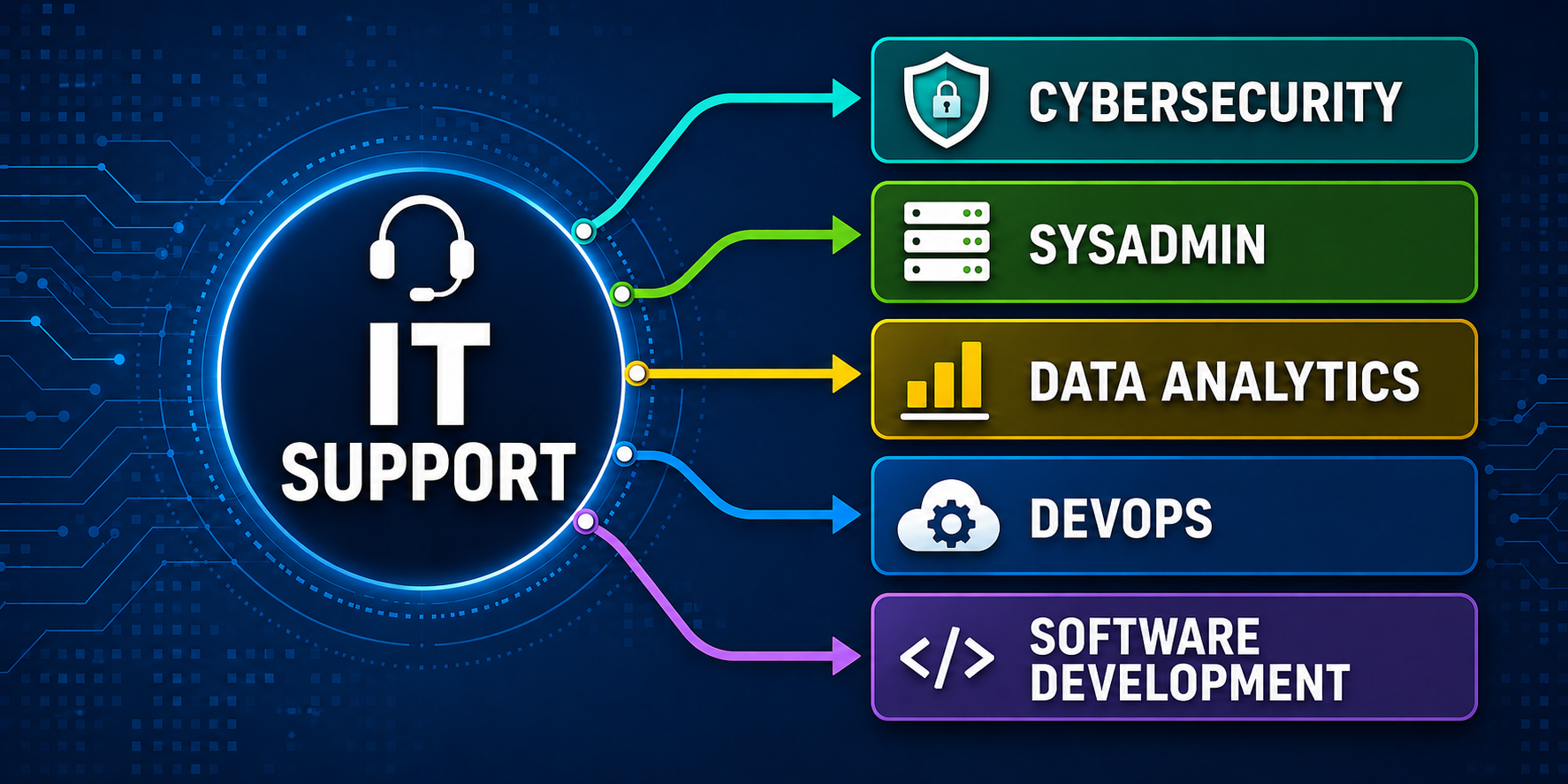
The difference is reactive versus proactive. IT support answers problems that have already happened to a person: a laptop that will not boot, an account that will not authenticate. Cybersecurity works on the systems those problems run through, preventing intrusions and responding when defenses fail. One is user-facing and ticket-driven. The other is systems-facing and threat-driven.
Cybersecurity usually expects a foundation before you arrive. Some background in IT support or networking is the common starting condition, because you cannot secure infrastructure you do not understand. CompTIA builds that assumption into its own credential: Security+ is aimed at people who already hold Network+ and have spent time in a security or systems administrator role. It follows naturally from the A+ and Network+ credentials support roles already use, which is part of why the two fields connect so cleanly.
Pay reflects the added specialization. Cybersecurity salaries sit well above IT support across the range, from entry level through senior.
None of that makes support a dead end. It makes it a stepping stone, and a well-worn one. The skills transfer, the certifications stack in a deliberate order, and the daily exposure to how systems break is the same exposure that teaches you how they get broken into. It is also worth knowing that cybersecurity is not one job: the federal NICE Framework maps 52 separate work roles under it, which is why "getting into security" looks different depending on which door you pick.
For the full breakdown of training, certifications and pay, see IT support vs cybersecurity.
IT Support vs. System Administrator
The difference is scope. IT support fixes one person's problem: a locked account, a failed print job, a laptop that will not connect. A system administrator keeps the servers, networks and systems that person depends on running for the whole organization.
The shift in responsibility follows from that. Support work is ticket-based and closes when the user is unblocked. Administration is measured in uptime, and the work does not close. A support technician is judged on how fast the queue clears. An administrator is judged on whether anything went down.
Three skills usually bridge the gap.
- Networking, enough to understand how traffic moves between systems rather than only how to reconnect one machine to it. CompTIA pitches Network+ at exactly this transition, recommending A+ plus nine to twelve months in a junior network or support role.
- Server management, covering provisioning, patching, backups and access control.
- Scripting, so a repeated fix becomes an automated one rather than a repeated ticket.
This is why system administration reads as an internal promotion rather than a separate career choice. Most of what you need, you can build from inside a support role, and the two jobs sit close enough that the move often happens without changing employers.
Dreambound covers the two roles side by side in computer network administration vs IT support.
IT Support vs. Data Analyst / Data Analytics
This is a bigger lateral shift than system administration or cybersecurity. Both of those stay close to infrastructure. Data analytics leaves it behind: the work is interpreting data to drive business decisions, not keeping the systems that produce it running.
The skill sets barely overlap. Support runs on troubleshooting and customer service. Analysis runs on four other things.
- SQL, for pulling the data out in the first place. The Labor Department's O*NET profile for data scientists lists database, business intelligence and statistical tools as the working kit.
- Spreadsheets, still the working surface for most day-to-day analysis.
- Data visualization, for making a finding legible to people who will never read the query.
- Statistics, enough to tell a real pattern from a coincidence.
People pivot here for reasons that have little to do with climbing. The day-to-day work is different in kind, more sustained and less interrupt-driven than a support queue, and the salary profile is stronger than support without requiring the security or infrastructure route to get there. It is a change of field rather than a rung on a ladder, which is why it takes deliberate retraining rather than time served.
What does carry over is not technical: working a problem methodically, and explaining a technical answer to someone who is not technical.
Dreambound compares the two paths in detail in IT support vs data analytics.
IT Support vs. DevOps / IT Automation
Automation work starts where support work repeats. A support technician resets the same password, provisions the same laptop, clears the same queue. An automation or DevOps engineer builds and maintains the pipelines that stop those tasks reaching a person at all. The unit of work shifts from the ticket to the system generating the tickets.
That makes it a natural next step for anyone in support who enjoys scripting and process improvement. Support experience is commonly listed as helpful rather than required for entry-level DevOps roles, and the sequencing shows up in how training is structured too: Google lists its IT Automation with Python certificate at advanced level and recommends completing the IT Support certificate first for anyone with no IT background.
Two things get added on top of that foundation.
- Scripting and coding, commonly Python, because automation is written rather than configured.
- Cloud tooling, because the pipelines run on cloud infrastructure rather than a server down the hall.
One caveat about the salary figures you will find elsewhere. BLS does not publish DevOps as an occupation. The work gets counted under software developers or under systems administrators depending on how an employer writes the job, which is why numbers for it vary so widely between sources.
Our breakdown of the Google IT Support certificate covers where the automation track sits in that sequence.
IT Support vs. Software Development
This is the most distinct comparison on the page. Support and system administration keep existing things running. Development builds new things and ships them. It is a build discipline rather than a maintain-and-troubleshoot one, and that difference runs deeper than the job titles suggest.
It also means the skill transfer is thin. Closing tickets does not teach you to design, write and release software the way it teaches you networking or server management. Where system administration and DevOps let you grow into the role from the job you already hold, this pivot generally starts outside it, through a bootcamp, a degree, or sustained self-study in one programming language until you can build something end to end.
On titles: programmer, developer and software engineer get used close to interchangeably in job ads and in conversation, and for the purposes of this comparison they describe the same shift away from maintenance and toward building.
Dreambound puts the two side by side in IT support vs software developer.
A Quick Note on "IT Support" vs. "IT Technician"
These two are not a comparison. They are the same job with two names, and BLS does not publish an IT technician occupation at all.
Where they do diverge, it tends to be employer terminology rather than seniority. Technician more often signals hands-on hardware work on site. Support more often signals remote or help-desk work. Plenty of employers use them the other way round, and the pay and responsibilities overlap either way.
Comparing the Paths at a Glance
The five paths sort themselves by one question: how much of what you already do carries over.
Barrier to entry sorts a little differently. System administration is the most accessible of the five from a support role. Cybersecurity, data analytics and DevOps sit at moderate. Software development is the highest, because it is the one that starts from scratch.
Frequently Asked Questions