Key Points
- A high school diploma or GED is the education floor in nearly every state.
- PTCB certification is accepted in all 50 states, though only some states require a national exam to register.
- Most states also require registration or a license from the board of pharmacy before you work.
- Continuing education keeps both a certification and a state credential active, and the two are tracked separately.
- Check your own state board before you commit, because these rules change on their own schedule.

General Requirements to Become a Pharmacy Technician
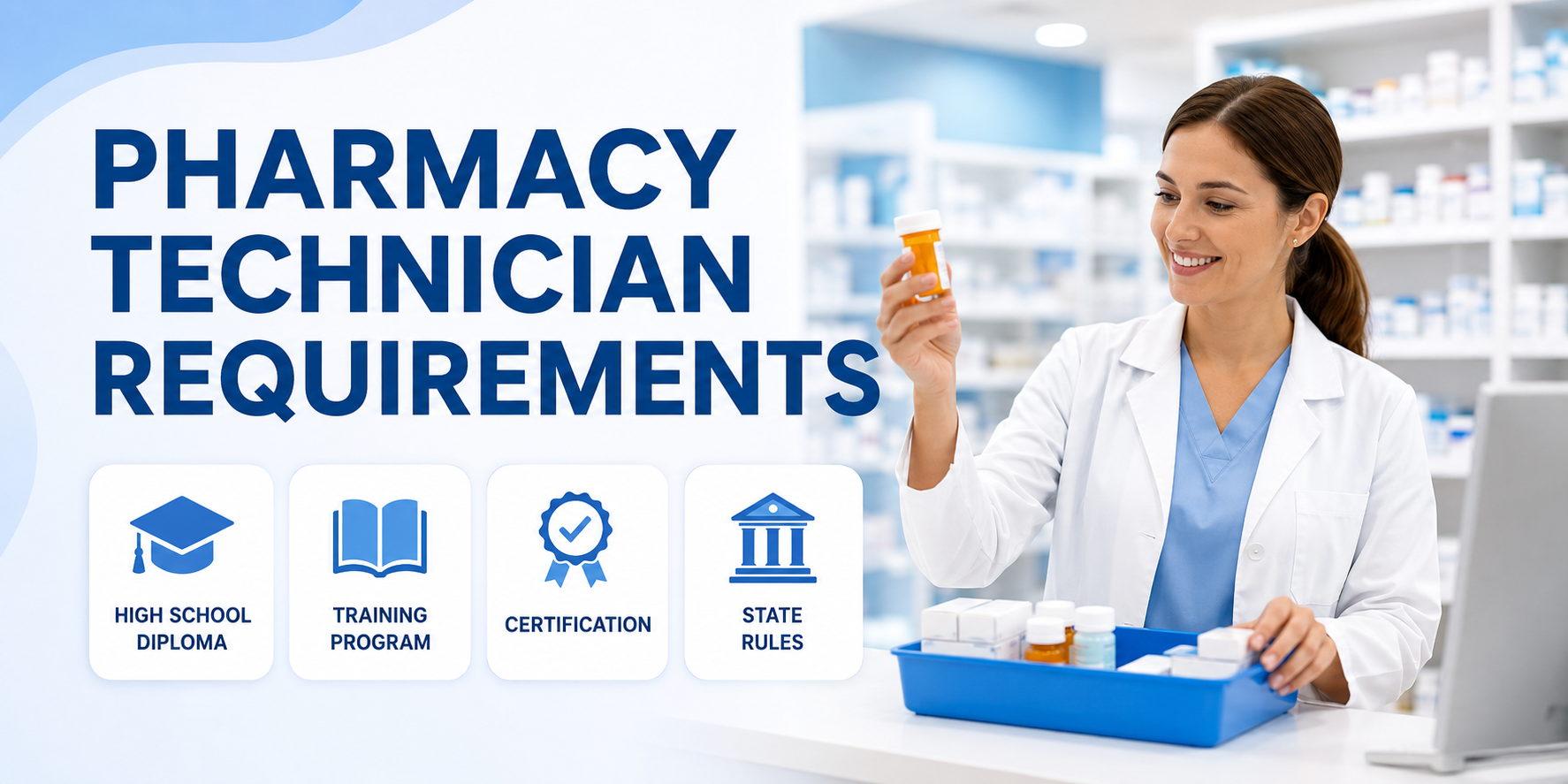
Two of those four requirements apply just about everywhere. You need a high school diploma or GED, and you need to clear a criminal background check. Most states add a minimum age. Everything past that is your board's call.
The age rule varies more than any other. Illinois will license a pharmacy technician at 16. Georgia and Florida both draw the line at 17. New York sets 18, and Ohio holds its certified tier back to 18 as well. Wisconsin also sets 18, unless you come in through an approved youth apprenticeship. Where a state runs two tiers, the higher one tends to carry the higher age.
The diploma requirement bends further than it sounds. Georgia will register you while you are still sitting in a high school classroom. Texas asks only that you hold a high school or equivalent diploma, or that you are working toward one.
Background checks are the piece almost nobody gets around, usually routed through a vendor like IdentoGO in Georgia or taken as fingerprints the way Texas does it. Drug screening is the one people confuse with it. That comes from the employer rather than the board, which is why it turns up in hiring paperwork instead of on your application.
Formal training is where the map stops being uniform. A certificate program or an associate degree is the common route, and in Florida it is the only route to registration. Georgia and North Carolina will register you without either. Go the certification path instead and both PTCB and NHA will count documented work hours in place of a program.
Pharmacy Technician Education Requirements
Three routes lead to the same job, and only two of them run through a classroom. BLS puts certificate programs at a year or less, describes a longer track that ends in an associate's degree, and notes that on-the-job training usually takes under a year as well.
Coursework barely varies between programs. Expect pharmacy arithmetic and dosage calculation, record keeping, dispensing methods, pharmacy law and ethics, and the names, uses, and doses of the drugs you will handle. Most programs attach a clinical placement so you work in a real pharmacy before anyone depends on you doing it right.
Accreditation is about to tighten. The ASHP and ACPE standard taking effect January 1, 2027 sets a floor of 400 hours for an accredited program, built from 100 didactic hours, 50 simulation hours, 120 experiential hours, and 130 the program director can allocate. It also collapses the old entry-level and advanced tiers into a single program level.
Skip school entirely and the certifying bodies price the alternative in work hours instead. PTCB counts 500 hours on the job. NHA wants a full year that includes at least 1,200 supervised hours. Those are experience thresholds, not program lengths, and they are the slower road.
Pharmacy technician was the second most-saved program on Dreambound in both 2024 and 2025, with 1,615 saves last year, according to the Student Choice and Interest Report. Format and cost separate these routes more than length does, since two of the three finish inside a year. Compare pharmacy technician programs on Dreambound by format and hours before you settle on one.
Pharmacy Technician Certification Requirements
Two exams carry national weight, and both end in the same three letters. PTCB gives the PTCE, NHA gives the ExCPT, and a technician who passes either one is a CPhT. Some states will not register you until you have passed one, others list it as a qualifying route, and most employers ask for it regardless of what the state says.
PTCB Certification (CPhT)
PTCB takes you two ways. Finish a PTCB-recognized education or training program, or document at least 500 hours of pharmacy technician work experience by the time you apply. Either way you also need U.S. residency and full disclosure of your criminal history and any state board actions against you.
The exam costs $129 with the application. It runs 90 multiple-choice questions, 80 of which are scored, inside a testing window of 1 hour and 50 minutes. Scores land between 1,000 and 1,600, and 1,400 passes. One practical detail catches people out: Pearson VUE, which delivers the exam, offers online testing for every PTCB credential except the PTCE, so this one has to be taken at a test center.
The content outline effective January 6, 2026 splits the exam four ways:
- Medications, 35%
- Patient Safety and Quality Assurance, 23.75%
- Order Entry and Processing, 22.5%
- Federal Requirements, 18.75%
CPhT is what you carry afterward. It is a national credential, not a license, and it does not by itself let you work in a state that requires its own registration.
ExCPT and Other Recognized Exams
The ExCPT runs 100 questions at a PSI testing center or through live remote proctoring, which is the one scheduling advantage it holds over the PTCE. Where a board names an accepted exam it usually names both, but not always, and a few states go their own way. Michigan will take an exam from a board-approved employer training program instead. Colorado stacks them: a national certification is a prerequisite there, but it does not authorize practice on its own until the State Board of Pharmacy issues its own certification on top. Ask your board and your employer which one they accept before you pay for either.
PTCB Renewal and Recertification Requirements
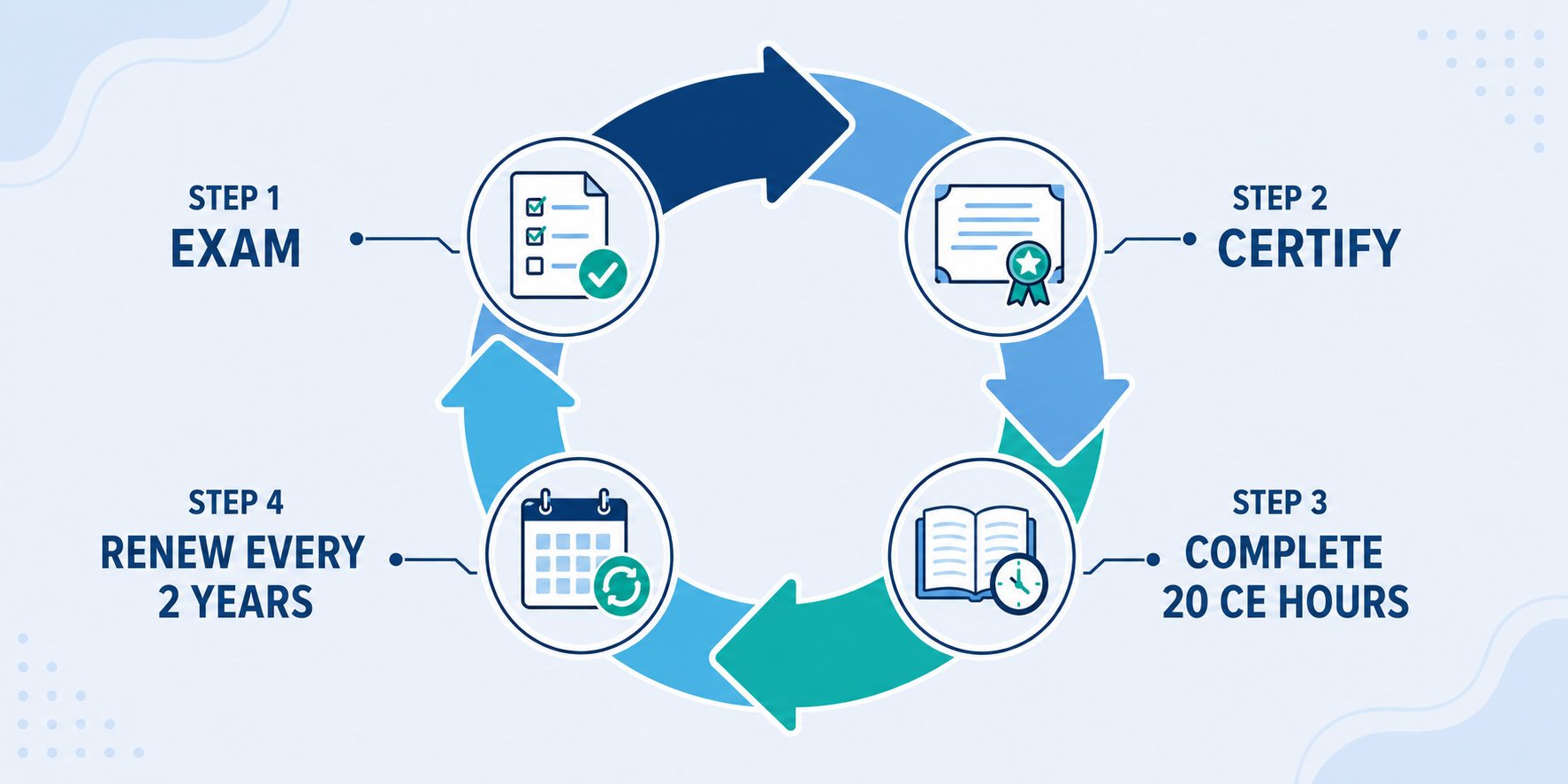
Recertification comes due every two years and costs $55, or $80 if you file late. Each cycle takes 20 hours of continuing education. PTCB's recertification policy requires one of those hours to be pharmacy law and one to be patient safety, allows up to 10 hours from a college course passed with a C or better, and does not let hours roll into the next cycle. You will need an NABP e-Profile and a CPE Monitor account to report them.
Let it lapse and the clock is short. You have one year to reinstate for $95, plus one extra hour of pharmacy law on top of the usual 20. Miss that window and reinstatement is gone entirely, and you start again under whatever eligibility rules are current.
Pharmacy Technician License Requirements by State
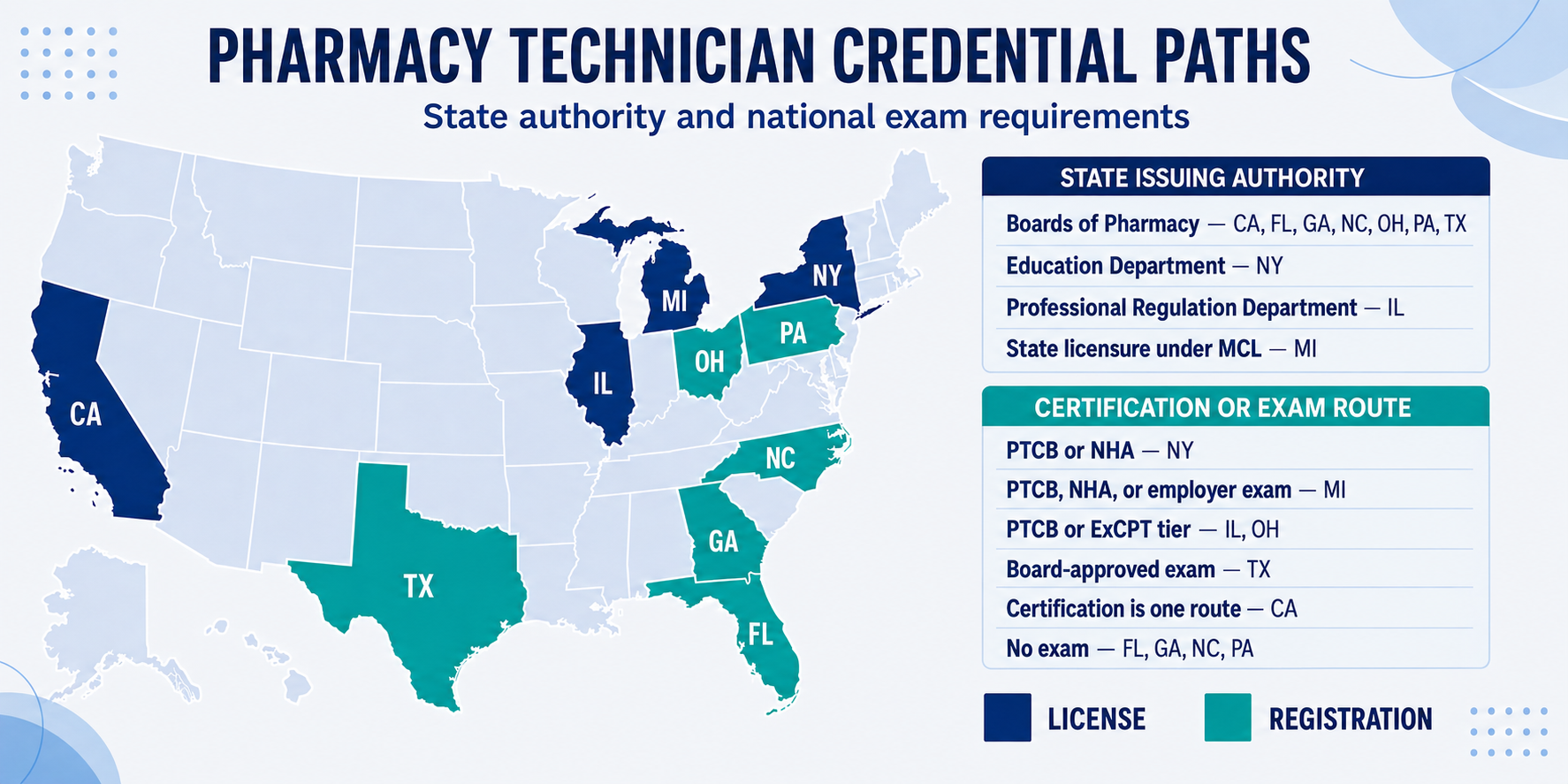
Pharmacy technician regulation is not federal, so "license," "registration," and "certification" mean different things depending on where you are standing. A license or registration comes from a state board and is your legal permission to work. A certification comes from PTCB or NHA and only proves you passed a national exam. Some states want both, most want just the state credential, and the states that want neither are getting hard to find.
The ten states below employ the most pharmacy technicians in the country, according to BLS Occupational Employment and Wage Statistics for May 2025. Together they account for a little over half the jobs.
Texas is the strictest of the group. Under 22 Texas Administrative Code section 297.3, registration with the Texas State Board of Pharmacy takes a high school or equivalent diploma, or work toward one, plus a passing score on a board-approved certification exam and a current certificate. The state also issues a trainee registration, granted once, never renewed, and dead two years from the date it was issued.
New York asks for much the same and charges more for it. The New York State Education Department requires licensure to use the title at all, sets the age at 18, and accepts certification only from PTCB or NHA. Licensure and first registration cost $175.
California takes the widest view of the ten. Business and Professions Code section 4202 asks the California State Board of Pharmacy for a high school diploma or GED, plus any one of four routes:
- An associate's degree in pharmacy technology
- A course of training the board specifies
- Graduation from a board-recognized school of pharmacy
- Certification from an NCCA-accredited body the board approves
Fingerprints are required either way, and the board asks for 45 days to process the application.
Florida is the one that trips people up. The Florida Board of Pharmacy requires registration, and it also requires a Board-approved training program before you can register, which is a step most states leave out. Initial licensure comes to $105 across three separate fees.
Michigan spells out what triggers the requirement. Under MCL 333.17739, anyone who assists in the dispensing process, compounds drugs, prepares intravenous drugs, or takes verbal prescription orders is serving as a pharmacy technician and has to be licensed for it.
Illinois splits the credential in two. A base license from the Illinois Department of Financial and Professional Regulation runs $40, expires every March 31, and needs nothing more than an attestation that you attended or finished high school. The certified designation is the one that requires a completed program and a passing PTCB or ExCPT score.
The Georgia Board of Pharmacy registers technicians at $100 with an IdentoGO background check and no exam, renewing before June 30 of odd-numbered years. The North Carolina Board of Pharmacy charges $30 and also skips the exam. If you are not nationally certified there, your pharmacist-manager carries the training obligation instead, covering terminology, calculations, dispensing, labeling, law, and record keeping within 180 days of your first shift.
The map is also moving. Colorado has required certification from its own State Board of Pharmacy since August 29, 2020, and national certifications have not authorized practice there on their own since that date, though one is still required to obtain the state credential. Pennsylvania registers technicians at $30 with no exam. Hawaii joined them this year: under Act 93, no person has been allowed to act as a pharmacy technician without a certificate of registration since January 1, 2026. Rules in this field change on their own schedule, so read your board's current page rather than any summary of it.
Employer Specific Pharmacy Technician Requirements
Large chains set standards on top of the state minimum, and the surprising part is which direction they push. The biggest ones do not demand certification up front. They hire you without it and pay to get you certified.
- Walgreens runs an "earn while you learn" apprenticeship that covers PTCB training and the exam fee and asks for no prior pharmacy experience. PTCB notes that new hires also get practice materials at no cost. National certification becomes a requirement for leadership roles rather than entry ones.
- Walmart states plainly on its careers site that it covers technician certification costs, and reported in January 2026 that more than 22,000 associates have completed their certification through the company since 2016.
CVS rounds out the three largest retail pharmacy employers in the country, though it publishes less about its trainee path than the other two.
The deadline that actually binds you comes from your state, not the company. Texas gives a trainee two years on a registration that cannot be renewed, and North Carolina gives an uncertified hire 180 days to finish employer training. Company onboarding runs on those clocks, not the other way around.
Continuing Education Requirements for Pharmacy Technicians
Getting certified is the part people research. Staying certified is the part that catches them out. PTCB and NHA both want 20 hours of continuing education every two years, and your state board may want its own hours on its own schedule.
California shows why guessing here is expensive. Since January 1, 2024, the California State Board of Pharmacy has asked technician licensees for exactly one hour of an approved cultural competency course in the two years before each renewal. That is the entire state requirement, and the board notes its law and ethics webinars are for pharmacists only. Pharmacists owe 30 hours. Technicians owe one.
Other states ask for more. Texas wants 20 contact hours per renewal period, at least one covering Texas pharmacy laws or rules, plus a human trafficking prevention course. Florida wants 20 as well, two of them board-approved medication error hours, with an HIV and AIDS hour added on a first renewal. Georgia also wants 20.
The hour counts often line up at 20. The required topics do not, and each set is tracked by a different body, so count them separately.